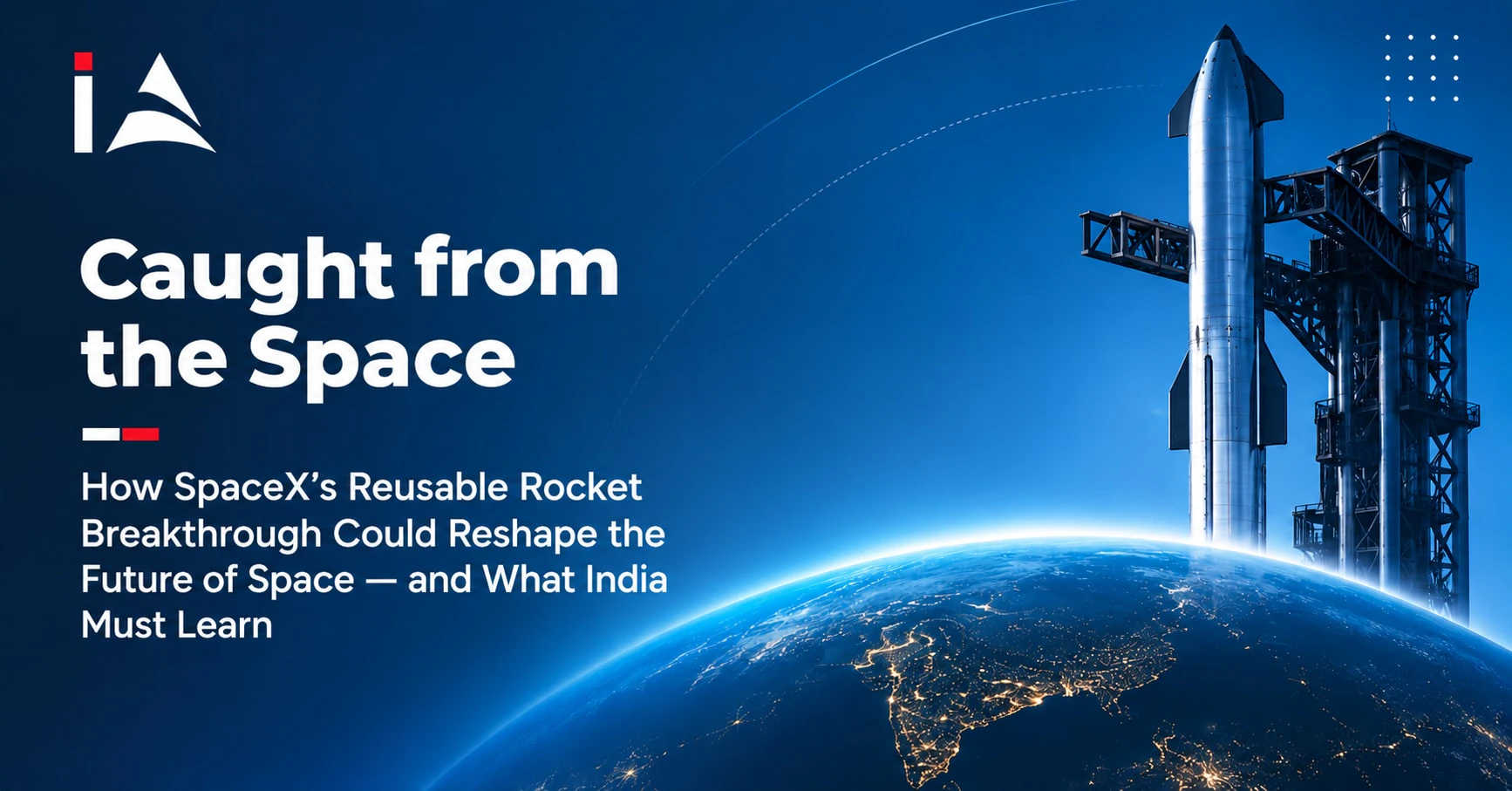
Caught from the Space: How SpaceX’s Reusable Rocket Breakthrough Could Reshape the Future of Space — and What India Must Learn
SpaceX has caught a Starship returning from orbit. A review by Dr PV Venkitakrishnan of what it means for launch economics, and what India must learn.
- Published
- Reading time
- 14 min read
A Review by Dr PV Venkitakrishnan
SpaceX just caught a spaceship returning from orbit. It changes the economics of space forever, and what India must adapt and learn.
For 68 years, we were using expendable or single use and throw rockets. The Space Shuttle also threw away its propellant tank. A rocket was built, fired once, and lost — either burned up in the atmosphere or sunk in the ocean waters.
That is why the return catch on 14 November 2026 matters. But it did not happen in one leap. It took almost two and a half decades, three generations of Falcon 9, hundreds of failures, and more than $15 billion US dollars.
2002-2010: Learning to Reach the Orbit
SpaceX was founded in 2002. Its first rocket, Falcon 1, failed on its first three launches between 2006 and 2008. The fourth, on 28 September 2008, reached orbit, the first privately developed liquid-fuelled rocket to do so. The company was nearly bankrupt. That success won NASA a $1.6 billion cargo contract in December 2008, which kept it alive.
Falcon 9 first flew on 4 June 2010. It was designed with nine Merlin engines. The first version, v1.0 (2010-2013), was fully expendable. It flew 5 times. The development cost of Falcon 9 itself was later disclosed as roughly $400 million, tiny by traditional standards.
2011-2015: Learning to Land, and Failing
In 2011, SpaceX began a formal reusable Falcon 9 programme, initially focusing on the first stage.
The path was deliberately public and painful.
- 2012-2013: Grasshopper, a suborbital test vehicle, made 8 vertical landings, including a 744 m hop, to prove the landing logic.
- 2013-2014: Falcon 9 v1.1 (2013-2016, 15 flights) tried controlled ocean descents. All failed to land intact, but each taught the team about grid fins, landing legs, and engine reignition.
- 2015: A series of drone-ship landing attempts ended in crashes, broadcast live. The first successful landing came only on 21 December 2015, when a Falcon 9 Full Thrust booster landed upright at Cape Canaveral after delivering 11 Orbcomm satellites. It was the first time an orbital-class booster had ever landed.
Elon Musk later announced that developing Falcon 9 reusability cost about $1 billion, on top of the base rocket. Together with recovery ships, refurbishment of LC-40 after the AMOS-6 pad explosion, and Merlin 1D development, the total Falcon 9 reusable system cost is estimated at about $1.5 billion.
2016-2018: From Landing to Reuse to Block 5
- 8 April 2016: First successful drone-ship landing.
- 30 March 2017: First reuse of a landed booster, proving recovery was not a museum piece.
- February 2018: Falcon Heavy flew, landing two side boosters together.
- 11 May 2018: Falcon 9 Block 5 flew for the first time. This is the present form. It was designed for 10 flights with only minor maintenance, and potentially 100 flights with periodic refurbishment. Thrust rose from about 4.9 MN in v1.0 to 7.6 MN in Block 5, and payload to low orbit more than doubled from about 10,400 kg to 22,800 kg expendable.
As of November 2026, the Falcon 9 family has flown 716 times with 712 full successes, 2 launch failures, 1 pre-flight failure and 1 partial failure. Boosters have landed 675 times in 688 attempts, i.e. 98.1% success, and 99% for Block 5 alone. One booster, B1067, has flown 37 times.
Marginal cost fell from a $69-74 million list price to an estimated $13-20 million per reused flight, because the booster, about 60% of the rocket's cost, is no longer thrown away.
2018-2026: Starship, the Harder Problem
SpaceX had been sketching a super heavy-lift reusable vehicle since 2005. The current design and name, Starship, were introduced in 2018.
2019-2021: Starhopper and the SN prototypes. Multiple high-altitude tests exploded on landing. Each failure drove a redesign of steel structure, Raptor engines, and heat shields.
20 April 2023: Flight 1, Starship exploded 4 minutes after lift-off.
2023-2026: Flights 1 to 13 had 8 successes and 5 failures. Flight 7 and 8 lost the Ship. Flight 9 lost the Ship again. But each flight added a capability.
Step 1: The Booster is Caught First
SpaceX solved reuse in the same logical order as Falcon 9, booster first.
The tower, nicknamed Mechazilla, is 145 metres tall. Its two arms, called “chopsticks,” slide up and down on rails. The returning vehicle hovers beside it, and the arms close on two small catch fittings near its top.
On 13 October 2024, SpaceX caught the Super Heavy booster, the 72.3 metre first stage, for the first time. It subsequently caught it three times, on Flights 5, 7 and 8.
Why go through all these cumbersome activities? Because the landing legs are dead weight. For Starship, legs would weigh 5 to 10 tonnes — 5 to 10 tonnes that cannot be satellites, cargo, or fuel for Mars. By putting the catch mechanism on the ground, where weight does not matter, SpaceX frees up all that mass for payload. And by catching the rocket back on its launch mount, it can be inspected, refuelled, and flown again in hours, not months.
The booster, however, only does a six-minute hop. It never goes to orbit.
Step 2: The Ship is Caught Next
The Ship does the real work. It goes to orbit, survives 1,600°C plasma, and comes back. Its windward side is covered with about 18,000 hexagonal ceramic tiles, and every one must survive. The Ship falls belly-first to spread the heat, then flips vertically and kills its velocity in seconds.
28 September 2026: Flight 14, Starship reached orbit for the first time, deployed 26 Starlink V3 satellites, and splashed down intact in the Pacific.
14 November 2026: Flight 15, the Ship was caught. A 52-metre spaceship, blackened by re-entry heat, fell out of the clouds at 17,500 mph, flipped itself upright, hovered for a few seconds and was caught by two giant mechanical arms.
No landing legs. No runway. No splashdown. Just steel grabbing steel.
It was the largest rocket ever built — 124 metres tall, with 33 Raptor engines on Super Heavy and 6 on the Ship. Ship 42 had spent 22.5 hours in space, completed 14 orbits, and deployed 26 Starlink V3 satellites. Then it came home to the same tower it had launched from.
The Double Catch is Still Pending
Can one tower catch both? Not at the same instant. One pair of arms can hold only one vehicle at a time. But yes, in the same mission, one after the other. That is SpaceX’s plan, and it is what Flight 15 attempted.
Falcon rockets were still not fully reusable. The second stage was thrown away in every single flight.
Elon Musk announced the double-catch goal on SpaceX’s Q3 earnings call on 20 October 2026, and said the odds on the first try were “more likely than not”, which means it is not guaranteed.
The plan was: Booster 22 returns and is caught about 6 minutes after lift-off. Ship 42 returns and is caught almost 22.5 hours later. The long gap gives the tower time to save the Booster, move it aside, and reset the arms.
But what happened? The Ship was caught, the first ever Ship catch. The Booster was not. Its boost back burn ended early on a low-fuel alarm, the guidance system aborted the catch, and it was diverted to the Gulf of Mexico and destroyed.
So the double-catch is still unproven. First the booster was caught. Then the ship was caught. What remains is to do both together, in one flight. For daily flights, SpaceX is building a second tower at Starbase, and new towers in Florida and Louisiana, so one tower is not blocked while waiting 22 hours for the Ship.
The cost of that lesson: SpaceX has spent more than $15 billion in developing Starship, according to its IPO filing reviewed by Reuters, nearly 40 times the $400 million spent on Falcon 9. NASA has contributed roughly $3.2 billion since 2021 for the Artemis lunar lander version. Each test flight costs an estimated $50-100 million. SpaceX devoted $3 billion to R&D in 2025 alone, all of it to Starship.
The Paradigm Shift in the Economics of Satellite Launching
A rocket is not an aeroplane. An aeroplane flies 30,000 times. A rocket flies once. Starship aims to change that equation. If both stages can be caught, checked, and reflown like an aircraft, the cost per kg to orbit could fall from $1,500, already low by Falcon 9 standards, to almost less than $100.
That is not just a saving. It is a civilizational shift. Affordable and economical launch means mega-constellations like Starlink, already 11,000+ satellites, become very affordable to maintain. One Starship can carry 60 Starlink V3 satellites. NASA’s Artemis programme needs Starship as its lunar lander. A Mars mission needs 10 to 15 tanker flights to refuel one Starship in orbit. That is only possible if you can launch every day.
The catch also proves a new philosophy: test fast, fail fast, learn fast. SpaceX has flown Starship 15 times in three years.
Traditional agencies would have taken 15 years to do the same. SpaceX treats failure as data.
What Does It Mean for India?
India cannot afford to watch from the side lines. And thankfully, we are not.
2020: The sector was open to private players. Today we have 440 Space Tech start-ups. India’s space economy is now around $9 billion, with a target of $44 billion by 2033. But the Starship catch has made one thing brutally clear: the future is reusable. Expendable is obsolete.
2024: ISRO chose a different architecture, not tower-catch, but a winged spaceplane. Its Reusable Launch Vehicle completed a hat-trick of autonomous landing experiments in 2024, landing on a runway like an aircraft. It is now working on an orbital return test.
In the same year, Chennai-based Agnikul Cosmos proved 3D-printed engines with Agnibaan SOrTeD.
July 2026: Hyderabad-based Skyroot Aerospace became the first private Indian company to reach orbit, on 18 July 2026 with Vikram-1, and has now become India’s first space tech unicorn. Its immediate focus is reliability and cadence, but reuse is on its long-term roadmap. It proves Indian private teams can build orbital-class rockets from scratch.
September 2026: On 25 September 2026, the Technology Development Board gave Agnikul Cosmos ₹200 crore under the RDI Fund to develop a fully reusable Agnibaan, not just the first stage, but a reusable upper stage too, taking it from TRL-4 to TRL-8. Agnikul is now building a ₹510 crore facility in Andhra Pradesh’s new Space City.
ISRO’s next workhorse, the Next Generation Launch Vehicle (NGLV), is being designed from day one with a reusable first stage using semi-cryogenic engines and vertical landing, the Falcon 9 model, the Indian version. The goal is a 10x reduction in cost.
The ecosystem is widening fast. EtherealX is building a medium-lift reusable rocket. Astrobase is building a 360-acre engine test facility in Andhra Pradesh. Hathor, Bellatrix and others are building propulsion and in-space mobility. Andhra Pradesh is building a ₹25,000 crore Space City just 40-60 km from Sriharikota, with engines in Tirupati, testing in Thimmasamudram, and R&D in Lepakshi. It is India’s attempt to build its own Starbase.
The Policy Foundation That Made This Possible
This private surge did not happen by accident. It was built, layer by layer, by policy.
24 June 2020, The Opening: The Union Cabinet opened the entire space value chain to Non-Government Entities. ISRO would focus on advanced R&D, exploration and human spaceflight. Routine manufacturing and operations would move to industry. New Space India Limited (NSIL), created in March 2019, became the commercial arm to demand-aggregate, market technologies, and transfer mature systems to industry. NSIL revenue has since grown from ₹321.77 crore in 2021-22 to over ₹3,000 crore in 2024-25, with 118 technology transfer agreements covering 83 ISRO technologies.
April 2023, Indian Space Policy 2023: The Policy gave legal clarity to what 2020 had promised. Private firms could now undertake end-to-end activities, build and operate launch vehicles, manufacture and operate satellites, build spaceports, and provide remote sensing, communication and navigation services. Indian users, public or private, were free to buy space services from any source, public or private. It formally defined three roles: ISRO for R&D, NSIL for commercialisation and IN-SPACe for authorisation and promotion.
The Role of IN-SPACe: The Indian National Space Promotion and Authorisation Centre, created as an autonomous agency under the Department of Space, is the single-window for private space activity. It does three jobs at once — promoter, regulator and facilitator. It authorises launches, satellites, spaceports and ground stations under its Norms, Guidelines and Procedures (NGP) issued on 3 May 2024. It gives private firms access to ISRO test facilities, launch infrastructure, data and technologies at nominal cost. It also handles mission safety, orbital and frequency coordination, and spacecraft registration.
By mid-2026, IN-SPACe had registered over 4,500 organisations, granted 113 authorisations to 52 entities (18 of them startups), signed 106 MoUs, and facilitated 71 technology transfers. It authorised all three private launches from Sriharikota so far — Skyroot’s Vikram-S (Nov 2022), Agnikul’s Agnibaan SOrTeD (May 2024), and Skyroot’s Vikram-1 (July 2026). Authorisation currently takes 75 to 120 days, a timeline that must keep falling if cadence is to rise.
FDI Policy, Opening the Capital Tap: Before 2024, FDI in satellites was allowed only through the government approval route. On 21 February 2024, the Cabinet liberalised it, notified on 16 April 2024:
- Up to 100% automatic: Manufacturing of components and systems / sub-systems for satellites, ground segment and user segment.
- Up to 74% automatic: Satellite manufacturing and operation, satellite data products, ground and user segment. Beyond 74% needs government approval.
- Up to 49% automatic: Launch vehicles and associated systems, and creation of spaceports. Beyond 49% needs government approval.
By mid-2026, the government had received 11 FDI proposals worth ₹1,745.40 crores. The message is clear. India wants global capital to manufacture in India, not just to buy from India. But for launch vehicles, being the most strategic segment, India has deliberately kept majority Indian control.
Central Government Research Grants and Risk Capital: The Funding Ladder
India has now built a funding ladder, from seed grant to patient capital. The gap is no longer money at the idea stage, but money at the flight-qualification stage, and anchor orders after that.
- IN-SPACe Seed Fund: Grants up to ₹1 crore per startup / MSME. Under its AI INSPIRED programme (Feb 2026), six start-ups, including Agnikul, Digantara, EON Space Labs and OrbitAid, received up to ₹1 crore each for AI in space, plus mentorship and ISRO facility access.
- Technology Adoption Fund (TAF): ₹500 crores, from Feb 2025. Covers up to 60% of project cost, capped at ₹25 crore, to take home-grown technologies from lab to market.
- ₹1,000 Crore Venture Capital Fund: Announced in Budget 2024-25, managed by SIDBI Venture Capital under IN-SPACe, to be deployed 2025-26 to 2029-30 at ₹100-250 crore per year, with tickets of ₹10-60 crore per startup. It is meant to crowd-in private VC, not replace it.
- RDI Fund, ₹1 Lakh Crores: Approved by Cabinet on 1 July 2025, launched on 3 Nov 2025, housed as a Special Purpose Fund in the Anusandhan National Research Foundation (ANRF), with DST as nodal department. It offers long-term, concessional financing at 2-4% interest, up to 15 years tenure with moratorium, collateral-free, up to 50% of project cost, for projects at TRL-4 and above. It is delivered through second-level fund managers, TDB and BIRAC first, now expanding to VC funds.
- Other Central Support: ISRO / Department of Space technology transfers, POEM (PSLV Orbital Experimental Module) flights that have carried 25 private payloads, and the Defence Ministry’s Technology Development Fund for dual-use propulsion and thrusters.
The RDI Fund is not a grant. It is structured risk capital, mostly as Optionally Convertible Debt. Agnikul’s ₹200 crore is OCD, meaning a soft loan that can convert up to 20% into equity. The same model was used for Manastu Space (₹116 crore for thrusters, project cost ₹277.63 crore), Dhruva Space (₹105 crore for a 500-kg satellite platform), and Astrome (₹64.05 crore for a space-based AI-ELINT constellation). TDB had approved 22 projects worth ₹2,192 crore of RDI support by mid-2026. The instrument is powerful, but disbursement has been slow and must be speeded up and made transparent.
The Investment Ecosystem: Where India Stands
Cumulative investment in Indian space startups has grown more than 6-fold, from $100.5 million in 2021-22 to $618.5 million by 31 March 2026. IN-SPACe facilitated $150 million of investment in calendar year 2025 alone. The top 10 start-ups now have confirmed order books of similar size.
Yet the scale gap remains huge. SpaceX spent $15 billion on Starship alone. India’s entire public capital stack: ₹1,000 crore VC fund + ₹500 crore TAF + RDI Fund disbursements so far, is still a fraction of that. Private VC in India is still cautious about hardware, long gestation and regulatory risk.
What is missing is not seed money, but:
- Series B/C growth capital for flight hardware.
- Anchor demand: multi-launch contracts from ISRO, NSIL, Defence and commercial constellation buyers.
- A Space Activities Act: India still runs on policy, not a Parliamentary statute. Liability, insurance, dispute resolution and licensing stability need a law to give long-term investors confidence.
States are now competing to fill the infrastructure gap — Andhra Pradesh’s ₹25,000 crore Space City, Tamil Nadu’s Kulasekarapattinam spaceport for small launchers, and Karnataka / Telangana clusters for satellites and components. The Centre must now ensure these do not become isolated islands, but one national supply chain.
Don’t Be Just a Follower, Leapfrog!
India should not try to build its own catching mechanism soon. We don’t have SpaceX’s budget or its 165 launches a year. But we must learn three lessons.
First, reuse is not a luxury, it is survival. If India’s rockets remain expendable, we will be priced out of the global launch market within five years, even though we are the most economical today.
Second, the government must be an anchor customer, not just a funder. SpaceX survived because NASA gave it contracts. Agnikul got ₹200 crore, but it needs launch orders. ISRO, IN-SPACe and the Defence Ministry must commit to buying launches from private Indian firms.
Third, failure must be allowed. SpaceX’s Flight 15 was half a failure, as the booster was lost. Yet it was celebrated as historic. In India, one failure often ends a career. If we want reusable rockets, we need a culture that allows rapid testing, even if it explodes on live TV.
For India, the message is clear. We mastered frugal, expendable rockets — PSLV, GSLV, LVM3 — and put Chandrayaan on the Moon for less than the cost of a Hollywood movie. Now we must master the next popular grammar: reusable, rapid, reliable. If we do, India will not just watch the catch. It will be made by its own engineering!
Frequently asked questions
What did SpaceX catch on 14 November 2026?
On Flight 15, SpaceX caught Starship’s Ship, the first Ship catch ever. A 52-metre spaceship, blackened by re-entry heat, flipped upright, hovered for a few seconds and was caught by the two arms of the launch tower. Ship 42 had spent 22.5 hours in space, completed 14 orbits and deployed 26 Starlink V3 satellites.
Why does SpaceX catch its rockets instead of landing them on legs?
Landing legs are dead weight. For Starship they would weigh 5 to 10 tonnes that could otherwise be satellites, cargo or fuel. By putting the catch mechanism on the ground, SpaceX frees that mass for payload, and a rocket caught back on its launch mount can be inspected, refuelled and flown again in hours, not months.
Has SpaceX caught the Booster and the Ship in the same flight?
Not yet. On Flight 15 the Ship was caught, but the Booster was not: its boost back burn ended early on a low-fuel alarm, the catch was aborted and it was destroyed in the Gulf of Mexico. The double catch is still unproven, and SpaceX is building a second tower at Starbase and new towers in Florida and Louisiana so one tower is not blocked while it waits for the Ship.
How much does reusing a rocket cut the cost of a launch?
For Falcon 9, the cost fell from a list price of $69-74 million to an estimated $13-20 million per reused flight, because the booster, about 60% of the rocket’s cost, is no longer thrown away. If both Starship stages can be caught and reflown, the article says the cost per kg to orbit could fall from $1,500 to almost less than $100.
How much has SpaceX spent on Starship?
More than $15 billion, according to its IPO filing reviewed by Reuters, nearly 40 times the $400 million spent on Falcon 9. NASA has contributed roughly $3.2 billion since 2021 for the Artemis lunar lander version, and each test flight costs an estimated $50-100 million.
What is India doing about reusable rockets?
ISRO’s Reusable Launch Vehicle completed three autonomous landing experiments in 2024 and is working on an orbital return test, and its Next Generation Launch Vehicle is being designed with a reusable first stage. Agnikul Cosmos received ₹200 crore under the RDI Fund to develop a fully reusable Agnibaan, and Skyroot Aerospace became the first private Indian company to reach orbit, with Vikram-1 on 18 July 2026.
What funding is available to Indian space start-ups?
The article describes a funding ladder: the IN-SPACe Seed Fund (grants up to ₹1 crore), the ₹500 crore Technology Adoption Fund, a ₹1,000 crore venture capital fund managed by SIDBI Venture Capital under IN-SPACe, and the ₹1 lakh crore RDI Fund, which offers long-term, concessional financing at 2-4% interest for projects at TRL-4 and above.
What does India still need to build a reusable launch industry?
The article names three gaps: Series B/C growth capital for flight hardware, anchor demand through multi-launch contracts from ISRO, NSIL, Defence and commercial buyers, and a Space Activities Act so that investors have a law, not only a policy, on liability, insurance, dispute resolution and licensing. It also argues for a culture that allows rapid testing and accepts failure.