

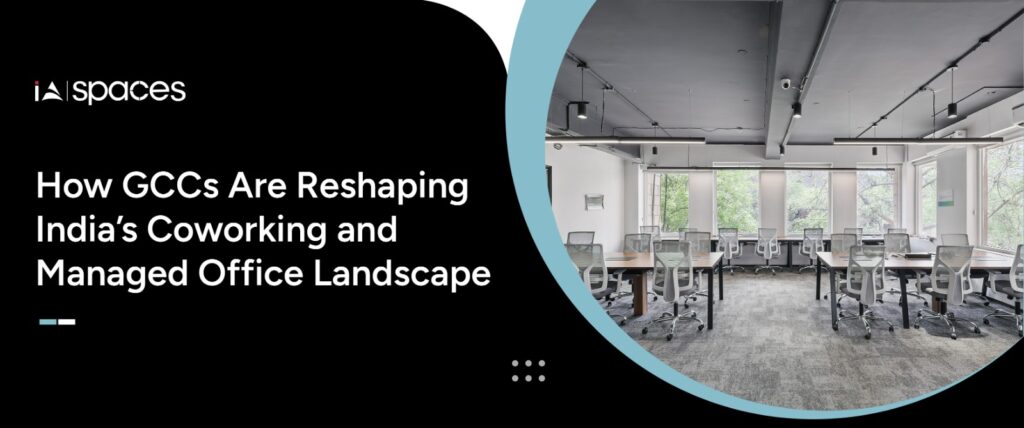
Why are global companies choosing flexibility over permanence in one of the world’s fastest-growing office markets?
Startups and independent professionals dominated searches for a coworking space near me. Today, the same query is increasingly being driven by multinational enterprises setting up Global Capability Centers (GCCs) in India. The motivation isn’t cost-saving; it’s speed, scalability, and access to talent.
India now hosts more than 1,600 GCCs, employing over 4 million professionals, with NASSCOM projecting this number to cross 2,000 by 2030. As these centers scale rapidly and unpredictably, traditional office models, long leases, heavy capital investment, and slow fit-outs are proving inadequate. This has accelerated demand for managed offices for rent and enterprise-grade coworking spaces, which offer global companies the flexibility to grow without compromising on control or quality.
GCC’s Growth Breaks the Traditional Playbook
The traditional office model was built on a comforting assumption: stability. Fixed floors and long-term leases are meant for organizations that grow slowly and predictably. GCCs don’t work that way. They are launched as focused pilot teams, scaled rapidly based on global mandates, and continuously reshaped as new capabilities are added from product engineering and data science to cybersecurity and R&D. Their growth is modular, fast, and rarely linear.
That’s why conventional leasing has quietly turned into a constraint. Long lock-ins, upfront capital expenditure, and months-long fit-outs struggle to keep pace with how GCCs actually operate. According to JLL India, over 45% of new GCCs now opt for flexible or managed workspace models over traditional offices.
In this environment, managed offices for rent have emerged as a strategic solution, offering global companies the ability to scale teams quickly, stay agile, and align workspace decisions with business momentum rather than real estate timelines.
Managed Offices Are No Longer a Workspace Choice
Managed offices are mostly misunderstood as an upgraded office culture. In reality, they serve a very different purpose. Designed for scale-hungry enterprises, it solves three critical problems of GCCs:
- Speed to market: offices go live in weeks, not months
- Scalability: teams can expand without renegotiating leases
- Enterprise readiness: security, compliance, IT, branding
According to CBRE, managed offices now represent the fastest-growing segment within India’s flexible workspace market, driven largely by GCC demand. Unlike a typical coworking space, these environments offer enterprises control, security, and scalability without the need for repeated lease negotiations.
As a result, what once felt like an alternative model is rapidly becoming core infrastructure for companies that treat office space as a growth enabler rather than a fixed asset.
Coworking Spaces Are Becoming Enterprise Gateways
Coworking spaces are still widely associated with hot desks and early-stage teams, but that perception no longer reflects how they are being used to scale. Today, enterprise-grade coworking space solutions host entire GCC teams, complete with private floors, controlled access, and dedicated infrastructure.
What was once positioned as a flexible alternative has evolved into a structured, secure environment capable of supporting complex, long-term business operations.
For many GCCs, coworking spaces act as
- Entry points into new cities
- Short-term innovation hubs
- Talent-led satellite offices
That’s why enterprise real estate teams increasingly search for coworking space near me, not to save money, but to move faster than competitors.
GCCs Are Redrawing India’s Office Geography
One of the most overlooked effects of GCC growth in India is the shift in office geography. As hiring expands, global companies are no longer anchored to Tier-1 CBDs. Instead, GCCs are establishing teams in secondary business districts, peripheral tech corridors, and Tier-2 cities where talent is deeper and attrition is lower.
Recent data shows that nearly 30% of new GCC expansions are now happening outside traditional CBDs, pushing demand for high-quality managed offices for rent in emerging micro-markets.
Office demand has shifted away from iconic locations and toward a more decisive factor: where talent chooses to live and work.
Offices Have Now Become Business Infrastructure
The most important shift in India’s office market is not about format or flexibility; it’s about intent. For GCCs, workspace decisions are no longer treated as real estate transactions; they are evaluated as part of business strategy. Offices are expected to enable faster hiring, support distributed teams, and adapt quickly as mandates expand or change. In this context, the workplace is no longer a static asset; it is an operational infrastructure that directly affects performance.
Workspaces are now expected to:
- Reduce hiring friction
- Improve employee experience
- Support rapid scale-ups and pivots
- Reflect global brand standards
Coworking spaces and managed offices are no longer alternatives to traditional offices; they are becoming the default model for how global companies operate in India.
Did You Know?
India’s flexible workspace market is projected to grow at over 15% CAGR through 2030, with enterprise-led demand (GCCs and large multinationals) accounting for the fastest-growing share, according to CBRE and JLL India. What began as a flexibility play is now a structural shift in how global companies enter, expand, and operate across Indian cities.
The Path Forward
GCCs have reshaped India’s office ecosystem by turning managed offices for rent and enterprise-grade coworking spaces into strategic infrastructure rather than flexible alternatives. What once supported speed now enables scale.
As a result, the future of India’s office market will be driven less by long leases and landmark buildings and more by adaptability and talent alignment, often beginning with a simple ‘coworking space near me’ search that now carries real strategic weight.
FAQs
Why do GCCs prefer managed offices for rent today?
Because they allow faster setup, easier scaling, and enterprise control without long-term lease commitments, models like IA Spaces are built to support.
How are GCCs using coworking spaces?
Enterprise-grade coworking spaces, such as those by IA Spaces, help GCCs enter new cities, build satellite teams, and scale around talent availability.
What makes IA Spaces significant in the GCC workspace shift?
IA Spaces aligns workspace design with GCC needs, speed, scalability, and compliance, reflecting how offices have become strategic infrastructure.
How do flexible workspaces support unpredictable GCC growth?
GCC growth is often modular and mandate-driven. Flexible workspaces allow companies to expand or reconfigure space in phases, aligning office capacity with evolving global business needs.
Is the shift toward managed offices a temporary trend or a structural change?
Current market data and enterprise adoption patterns suggest this is a structural shift. Flexible and managed workspace models are increasingly becoming the default infrastructure for GCC expansion in India.